


Summary
Agile leadership helps leaders navigate change with confidence through four key practices: regulating emotions, adopting a learning mindset, fostering innovation, and using creativity to solve problems. These practical strategies will help you build resilient teams, adapt to uncertainty, and lead more effectively through change
Before we dive into our topic, let's do a quick experiment. Cross your arms as you normally would. Now, switch them so the opposite arm is on top. Feels awkward, doesn’t it? And how many of you had to glance down to figure out how to make the swap?
We experience a similar disorientation whenever a new process, technology, or business strategy disrupts our routine. Our brains naturally rely on familiar habits because they're efficient. But today's workplace changes too quickly for leaders to depend solely on what worked yesterday. Although leaders can't control every circumstance, they can control how they respond. That's the essence of agile leadership.
Agile leaders respond to uncertainty with curiosity instead of resistance. They intentionally seek new experiences, challenge assumptions, and continuously adapt so they (and their teams) can thrive through change.
Building agile leadership starts with four practical habits: regulating emotions, adopting a learning mindset, fostering innovation, and using creativity to solve problems. Together, these best practices help leaders navigate uncertainty, build resilient teams, and turn change into opportunity.
What Is Agile Leadership?
Agile leadership is the ability to adapt, learn continuously, and thrive in new or uncertain situations. Agile leaders anticipate change, embrace challenges, and evolve with their circumstances.
Change is like a powerful current—you can fight against it, let it sweep you along, or harness it to move forward. Welcoming change and using it to grow allows you to harness its momentum. This is how leaders and their teams can thrive in uncertainty and drive progress.
Why Is Agile Leadership an Essential Skill for Leaders?
In today’s fast-paced world, where rapid technological shifts and global events constantly reshape markets, leadership can feel like navigating an obstacle course. New challenges pop up around every corner, and there isn’t a map. To stay ahead, leaders can’t rely on what they already know. They must learn quickly and leverage change to drive progress.
Leaders can’t count on tried-and-true playbooks because the challenges they face are complex and ever-changing. The most successful leaders experiment, gather insights, and adjust their approach along the way.
Agile leadership enables leaders to transform uncertainty into opportunity. From rethinking outdated processes to staying ahead of the curve during industry shifts, agile leaders inspire their teams and move their organizations forward. By encouraging agile leadership, businesses turn disruptions into advantages and outpace competitors stuck in the status quo.
This capability has never been more important. DDI's Global Leadership Forecast found that 83% of HR organizations expect leadership skill requirements to increase significantly over the next five years, yet critical future-focused capabilities, including managing change and setting strategy, remain underdeveloped. Organizations that intentionally build these capabilities will be better positioned to adapt and compete.
By developing agile leadership across the organization, companies are better equipped to navigate disruption and build resilient, future-ready teams.
How to Develop Agile Leadership
Given the importance of agile leadership, how can HR and learning and development (L&D) professionals help grow this skill in their organizations?
Rather than viewing agility as an innate personality trait, organizations should treat it as a leadership capability that can be assessed, developed, reinforced, and incorporated throughout the talent lifecycle.
Start with these four areas:
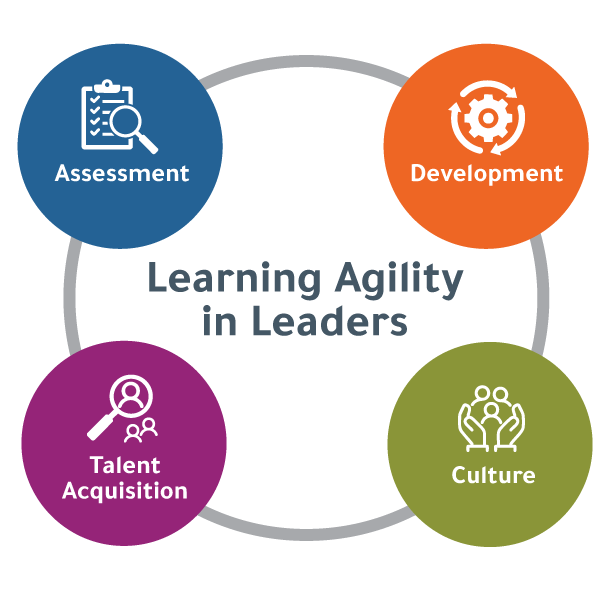
Assessment
Building agile leadership begins by recognizing it as a skill on a spectrum. Some leaders naturally absorb and apply new information, while others benefit from more intentional development.
Leadership assessments help organizations understand where leaders currently excel and where they need additional support. DDI's research shows that organizations strengthen their leadership bench by continuously mapping leadership capabilities, identifying skill gaps early, and using those insights to deliver more targeted development.
Development
With insights from assessments, L&D professionals can design personalized development experiences to align with each leader’s unique starting point while stretching their capabilities.
For highly agile leaders, this might mean creating opportunities for them to tackle complex challenges across a variety of business contexts. For leaders who tend toward more fixed mindsets, focus first on developing foundational skills such as hypothesis testing, rapid experimentation, and recovery from setbacks.
Targeted development matters because organizations that personalize leadership development are significantly more likely to improve leadership capability than those relying on one-size-fits-all training.
Talent Acquisition
Include agile leadership as a screening criterion in leadership hiring and succession planning. Hiring leaders who demonstrate curiosity, adaptability, resilience, and openness to learning helps organizations build a stronger leadership pipeline prepared for future change.
Culture
Promote a culture that values curiosity over certainty. This creates an environment where leaders feel safe sharing uncertainties, and where learning from missteps is valued just as much as getting it right the first time.
These organizational practices lay the groundwork for agile leadership, but developing the capability ultimately depends on how leaders show up every day.
The following four best practices help leaders put agile leadership into action.

Best Practice #1: Lead with Emotional Regulation
Unregulated emotions can stall progress, but emotional self-awareness helps you recognize and manage your feelings effectively. And for leaders guiding teams, this skill is especially crucial for providing support and direction.
Emotional regulation doesn’t mean suppressing initial reactions to change. Instead, leaders should sit with their feelings first and build a tolerance for emotions, especially negative ones. This creates space for openness, flexibility, and trying new things.
The ability to manage emotions has never been more important as leadership demands intensify. DDI's Global Leadership Forecast found that 71% of leaders report increased stress since stepping into their current role, and 54% are concerned about burnout. Leaders who can regulate their emotions are better equipped to navigate uncertainty, make sound decisions, and support their teams through change.
One way leaders can do this is by pausing to notice their reaction before jumping into action. While this may seem counterintuitive when developing agility, taking time to reflect ensures their response is grounded in clear judgment, not emotional overwhelm. Then, they can better align their next steps with the outcome they want to achieve.
Other techniques leaders can use to regulate emotions include:
- Processing emotions by talking through them with someone they trust.
- Keeping a log of feelings towards change to identify patterns or warning signs.
- Practicing stress-reducing activities like breathing exercises.
By practicing these techniques, leaders achieve positive results for themselves and their teams. Leading with emotional regulation:
Creates Psychological Safety
Emotional regulation fosters a culture in which team members feel secure taking risks and sharing concerns. As a result, they benefit from better collaboration and more innovative ideas.
Improves Decision Making Under Pressure
Leaders who manage their emotions can make clear, unbiased decisions even in tough situations. This helps maintain team focus and productivity.
Builds Resilience in the Team
Remaining calm in adversity teaches teams to handle setbacks constructively, increasing their adaptability.
Encourages Open Communication
Regulated emotions lead to better listening and response patterns, promoting honest, solution-focused discussions.

Best Practice #2: Lead with a Learning Mindset
An agile approach requires an openness to learning. Leaders who practice a learning mindset are more effective during uncertain times, as they know that good ideas can come from anywhere. This mindset helps them navigate complex situations with curiosity and agility, continually fine-tuning their approach and learning from their experiences.
Continuous learning has never been more important. Our research shows that 83% of HR organizations expect the need for new leadership capabilities to increase over the next five years, yet many of those critical capabilities remain underdeveloped today. Leaders who embrace a learning mindset are better prepared to build the skills they'll need to succeed as business demands continue to evolve.
Leaders can become better learners by:
- Starting their day with questions and a desire to discover, rather than feeling pressure to have all the answers.
- Proactively seeking knowledge and embracing curiosity. For example, researching new ideas, talking to people with different viewpoints, learning about their customers, or asking thoughtful follow-up questions.
- Looking for growth opportunities and using every experience—whether a success or a setback—as a chance to develop new skills and apply those lessons in the future.
When leaders take steps to lead with learning, it:
Accelerates Skill Development
Teams are motivated to improve their skills and grow their knowledge, preparing them for rapid change.
Promotes Growth-Oriented Feedback Culture
Leaders who are open to learning set an example for accepting feedback, making improvement-focused feedback a norm for the team.
Enhances Problem-Solving Abilities
A learning-focused team is more willing to test new solutions. A team like this adapts quickly when faced with challenges.
Builds a Culture of Curiosity
A focus on learning encourages employees to seek knowledge beyond their roles. This drives proactive problem solving and cross-functional agility.

Best Practice #3: Lead with Innovation
Fostering innovation means improving current practices by embracing fresh ideas, knowledge, and methods. Sometimes, this involves refining what works; other times, it means replacing outdated approaches entirely. Innovation helps leaders keep pace with shifting demands while strengthening the flexibility they need to navigate periods of uncertainty.
There are many ways to practice innovation. For example, leaders can test new ideas with a focus on learning what works and what doesn't without fear of failure. This mindset encourages experimentation and can lead to meaningful breakthroughs.
Other ways leaders can foster innovation include:
- Regularly questioning their current methods.
- Gathering feedback and ideas from others to learn from fresh perspectives and challenge their thinking.
- Staying open to iteration and adapting through multiple phases.
Leading with innovation in the workplace:
Increases Solution-Finding Capabilities
An innovative approach helps teams explore solutions and adapt quickly to unexpected problems.
Supports a Culture of Experimentation
Teams feel safe to test new ideas without fear of failure so they can make quick adjustments when strategies change.
Drives Competitive Advantage
Innovative leaders guide teams to think ahead, allowing them to anticipate and respond faster to market changes.
Inspires Continuous Improvement
Innovation encourages teams to refine processes and methods, keeping the organization agile and prepared for change.

Best Practice #4: Lead with Creativity
Change is a marathon, not a sprint. While agility is often associated with speed, true agility is about sustaining momentum over time. That requires leaders to slow down long enough to explore diverse solutions and consider a wide range of ideas.
Innovation plays a key role in driving change by creating, testing, and applying new ideas. Creativity takes that a step further by encouraging leaders to think beyond conventional solutions and explore new possibilities. Creativity thrives when leaders shift from reacting to daily problems to seeking inspiration and exploring ideas. For example, jotting down a full page of ideas—even if they seem impractical—before choosing one can help you find the best approach. (Bonus points for using a physical pen and paper to break away from the speed of typing and think even more deliberately!) Taking time to reflect often fuels more effective solutions.
Other ways to foster creativity include:
- Looking for inspiration everywhere, even in unrelated fields or activities.
- Approaching problems with an outside-the-box mindset.
- Remembering the best solution is rarely the first one you think of.
- Challenging conventional thinking and exploring alternatives before committing to a decision.
There are many benefits to carving out a space for inspiration at work. Leading with creativity:
Encourages Unique Perspectives
Teams feel empowered to bring diverse ideas, helping them to adapt to evolving needs and approach challenges with fresh solutions.
Enhances Flexibility in Problem Solving
A creative mindset helps leaders and teams pivot and adapt, responding effectively to unexpected situations.
Reduces Resistance to Change
Creativity encourages openness to change, making it easier for teams to embrace new methods, tools, or strategies.
Fosters Team Engagement
Creative environments are engaging. They energize employees to take active roles in evolving team dynamics and goals.
Why Agile Leadership Defines Tomorrow's Leaders
In today’s business landscape, yesterday's solutions rarely solve tomorrow's challenges. Agile leadership isn't just another leadership competency—it's the master key that unlocks sustainable success.
Every day, leaders face unprecedented problems, complex decisions, and opportunities that demand a fresh perspective on what’s possible. At this relentless pace, the difference between thriving and surviving often comes down to how quickly leaders can learn, adapt, and act in unknown territory.
As HR and L&D professionals, we have the power to shape agile leadership across our organizations. In fact, developing agile leaders is perhaps the most impactful way we can drive long-term business success. But beyond improving performance, helping leaders build true agile leadership equips them with resilience to find their footing in roles that can often feel overwhelming.
When leaders embrace agile leadership, they don't just adapt to change; they help their teams grow through it. By building emotional regulation, a learning mindset, innovation, and creativity, leaders can confidently navigate uncertainty while creating lasting business impact.
Ready to build agile leaders who thrive through change? Explore DDI's Change Leadership solutions to see how assessments and targeted development build leaders who thrive through uncertainty.
About the Author:
Meagan Aaron is a managing consultant with 25+ years of advising clients on their talent management strategies that scale all levels of the leadership pipeline. When she’s not leading account teams or coaching executives, she supports the Memphis community by coaching small women business owners and upskilling leaders at nonprofits.
Have a Question?
Frequently Asked Questions About Learning Agility for Leaders
-
What is agile leadership and why is it important?

Agile leadership is the ability to adapt quickly, learn continuously, and lead teams effectively through change and uncertainty. It helps leaders respond to new challenges, support their teams, and drive better business outcomes in rapidly changing environments.
-
How can leaders become more agile?
Leaders become more agile by practicing emotional regulation, adopting a learning mindset, fostering innovation, and using creativity to solve problems. Leadership assessments, feedback, coaching, and targeted development also help build agile leadership skills over time.
-
What skills are essential for agile leadership?
The most important agile leadership skills include emotional regulation, continuous learning, innovation, creativity, adaptability, and decision-making under uncertainty. Together, these skills help leaders navigate change while keeping teams engaged and focused.
-
How does agile leadership help organizations navigate change?
Agile leadership enables organizations to respond more effectively to change by helping leaders make informed decisions, encourage innovation, support employees through uncertainty, and adapt strategies as business needs evolve.
-
How can organizations develop agile leaders?
Organizations can develop agile leaders by using leadership assessments to identify skill gaps, providing personalized development experiences, creating opportunities to practice new behaviors, and fostering a culture that values learning, experimentation, and continuous improvement.